
New Voters, Same Old Incumbency
Cook Is Screwing An Alabama Democrat, Part 1

Last week, the Cook Political Report made a frankly baffling judgment. With Alabama Republicans gerrymandering the Dem-held AL-02 into a Trump+14 district, they determined its incumbent Democrat, Shomari Figures, had no path to victory, and rated his seat Safe Republican – a move that hamstrings Figures’s campaign from the start.
To be clear, they did not rate AL-02 as Safe because it was too red. As they themselves acknowledge, “there are competitive races in other seats that Trump won by double-digits.”
Instead, their reasoning was two-fold. First off, the new AL-02 is very racially polarized, and Cook believed this made it uniquely difficult for Figures to hold on. Next, Figures is based in Mobile (which was drawn into AL-01), while the new seat is based in Montgomery and the Wiregrass, and Cook implied the unfamiliar territory would also make his race difficult.
I take great issue with both of these reasons, but I’ll leave the dubious notion that racial polarization = fewer swing voters for Part 2. Today, I want to address the other claim: that new territory alone is a particularly difficult challenge for incumbents.
IT AIN’T THE 2000s ANYMORE
For what it’s worth, this idea is historically accurate. Infamously, in 2003, Texas Republicans conducted a similar mid-decade redistricting that shoved new territory into the districts of Southern Democrats. Even though many districts didn’t get significantly redder, a lot of Democrats relied on winning over swaths of Republicans to win, and gaining new unfamiliar voters was enough to doom many incumbents.
This, however, is mostly a relic of a bygone age. Today, very few federal incumbents post enormous overperformances based on familiarity. And thus, the effect of acquiring new territory is limited.
To prove this, let’s take a look at 2024. That year, 25 incumbents had their seats redrawn with >10% of their district being new, while facing an opponent from the opposing party. In the old parts of their seats, incumbents outran their party’s presidential candidate by an average of 3.9%. In the new parts, they outran by an average of 2.9% – only 1% less! 19 of the 25 incumbents still outran the top of the ticket in their new areas despite being new to their constituents.
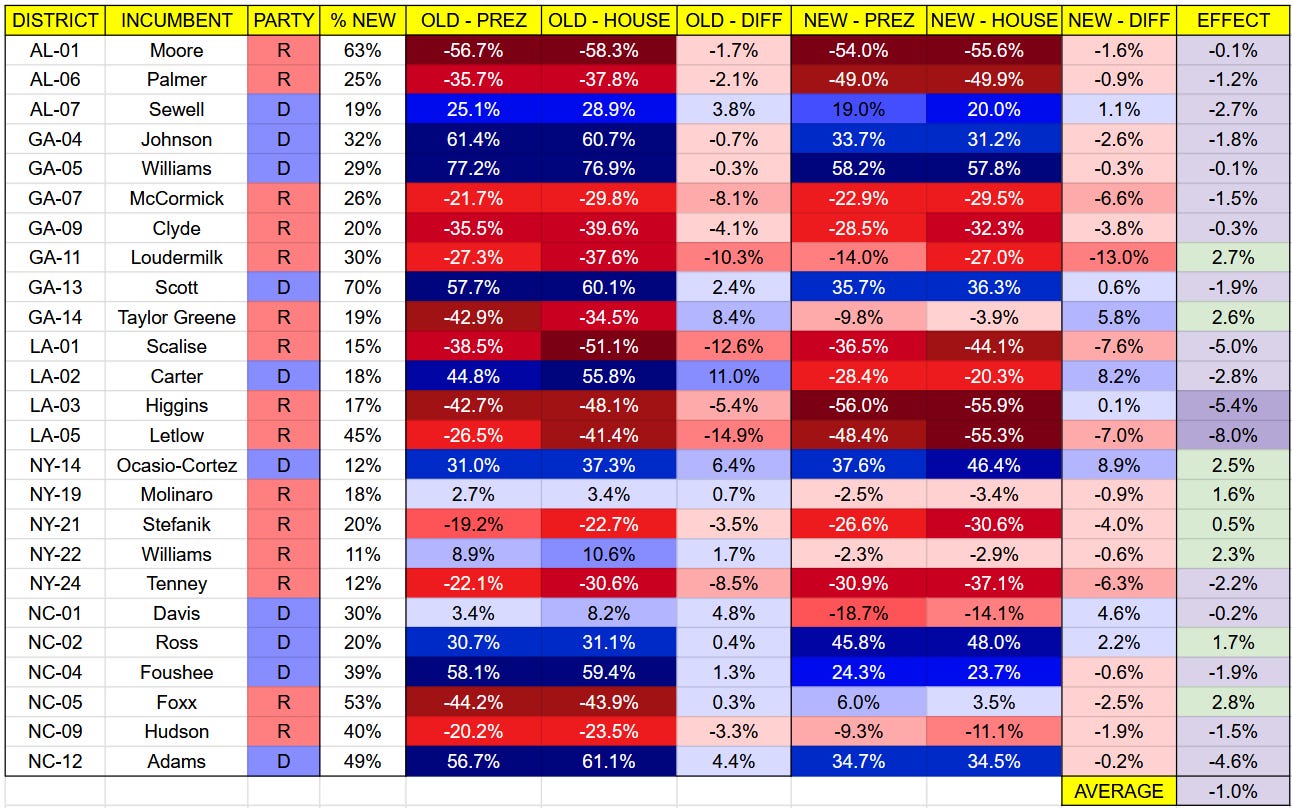
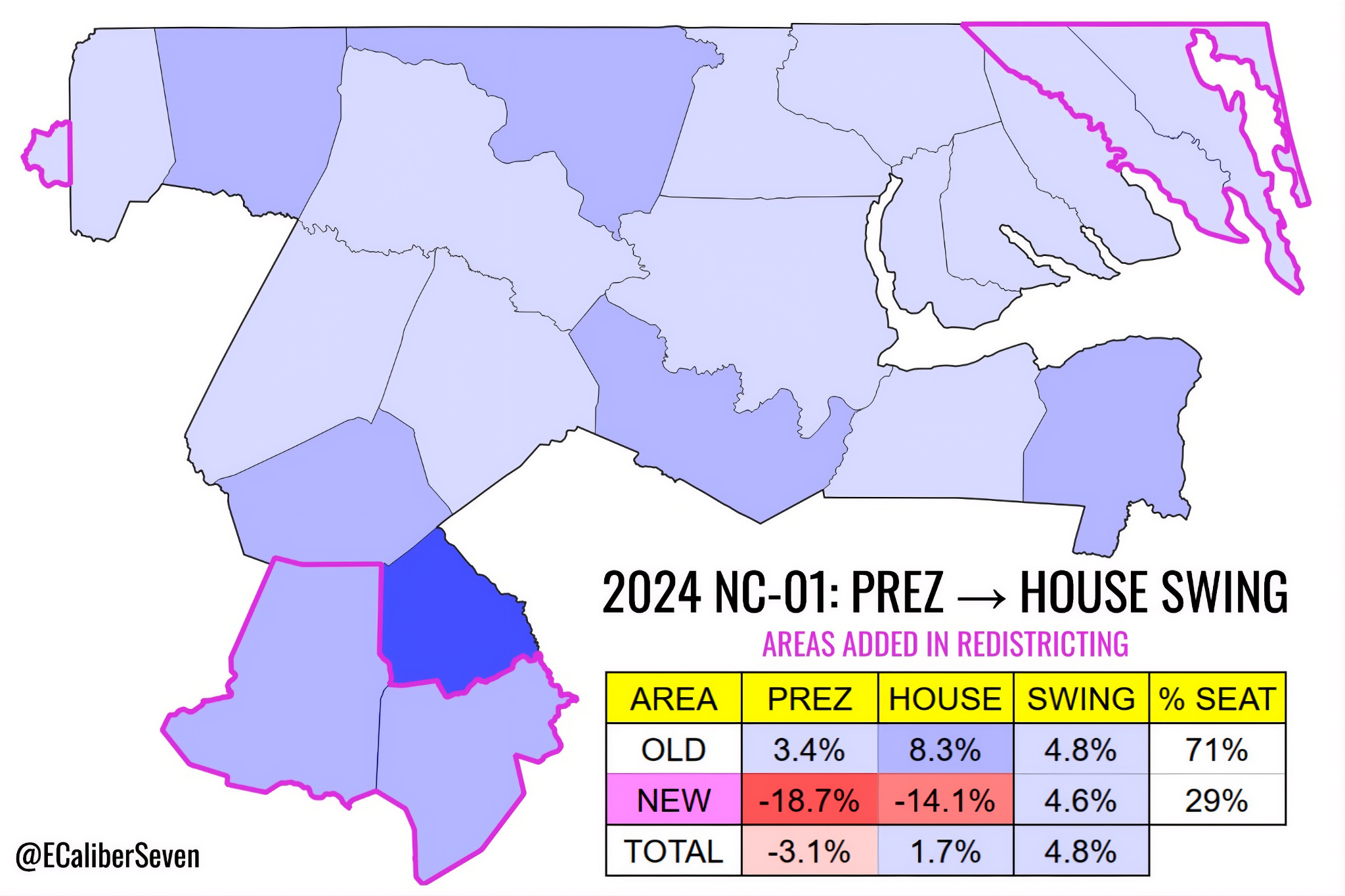
This phenomenon isn’t limited to uncompetitive races, where perhaps only one party is trying to reach the new voters. This list includes three competitive races: NY-19, NY-22, and NC-01. Funny enough, the incumbent Republicans in NY-19 and NY-22 actually performed better in their new territory, outrunning Trump among their new constituents, while underperforming with their old ones. In NC-01, Democrat Don Davis performed nearly identically with both his new and old constituents – a relevant fact as he faces down yet another redrawn seat in 2026.
This is replicable in 2022 as well, where the sample size is much bigger, but the comparison isn’t as clean. Across the 179 races I could collect data for, incumbents outran the 2020 presidential results by only ~1% more with their existing voters than their new ones. This remained the case among the 36 competitive races in the set.
The era of incumbents losing races simply because of unfamiliar territory is over. What matters now is the underlying partisan math – and that’s where Cook’s rating of AL-02 falls apart.
THE MATH SAYS FIGURES CAN WIN
Analyzing Figures’s chances requires some math, so if you don’t want the details, feel free to skip to the end of the section.
First off, Figures ran an expensive, Likely D race for the open AL-02 in 2024, with both parties spending over $4 million each – giving us a good test of how he performs under competitive conditions.
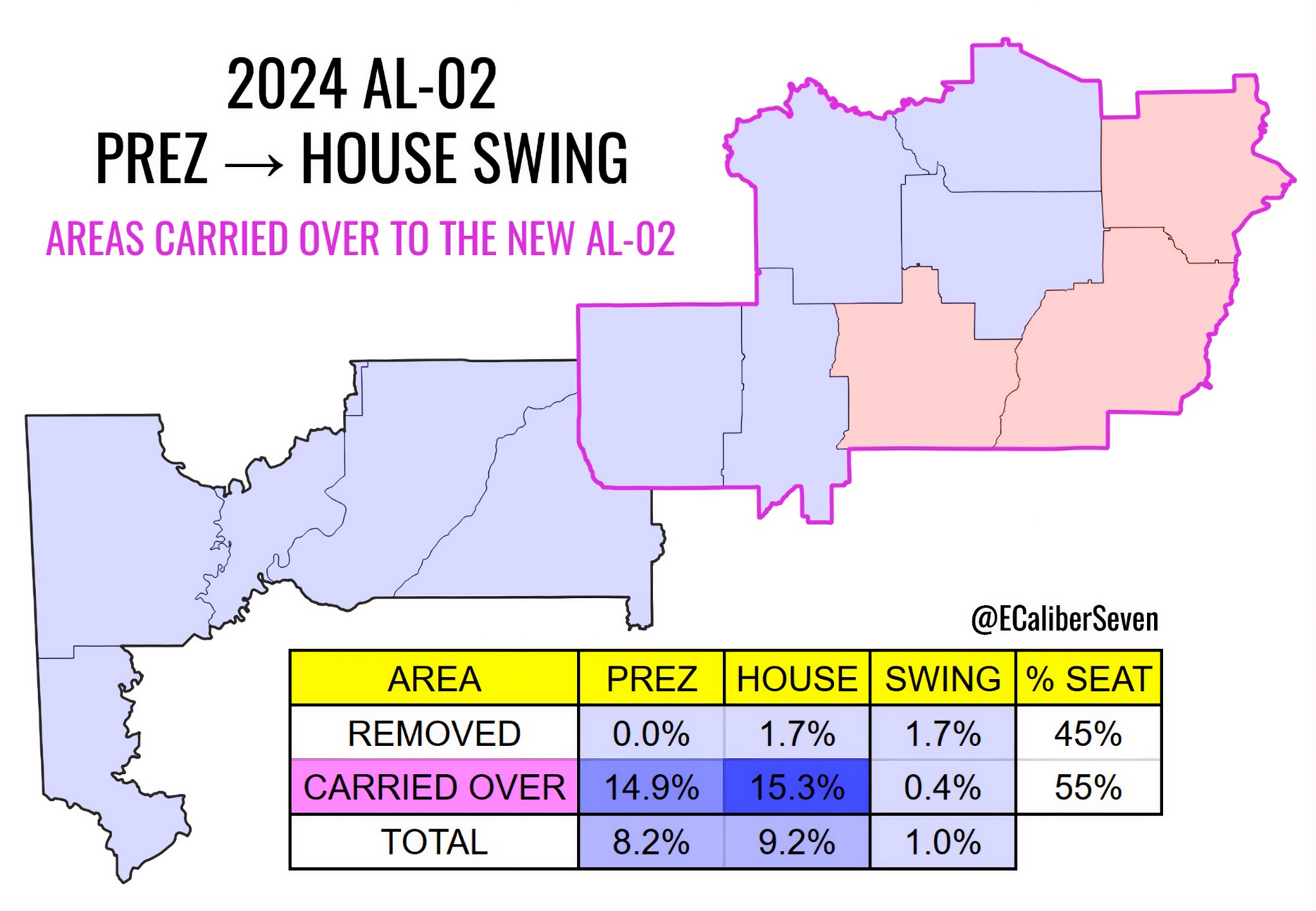
Districtwide, Figures outran Kamala Harris by 1%. As Cook pointed out, Figures’s base was in Mobile (in the west), and he did indeed outrun Harris by 1.7% in the portion not carried over to the new AL-02. However, he still outran Harris by 0.4% in the area carried over, only slightly less than in the west.
Thus, we can establish that Figures is not a weak candidate, given that he outran Harris in an open race.
Next, let’s model out how Figures would do in his new Trump+14 AL-02. Figures represents 55% of the new seat in Congress, with the other 45% being new. On average, incumbents outran the baseline by ~3%. The previous section’s data found that incumbents did an average of ~1% worse in the new parts of their seat, so we can estimate Figures to outrun the baseline by ~2% in his new territory. This results in a combined average incumbency bonus of ~2.5%.
According to Silver Bulletin’s generic ballot average, generic ballot polls (polls asking which party you’d vote for in Congress) show Democrats leading by an average of ~7%. For reference, Trump won the popular vote in 2024 by 1.5%. Thus, polls are currently projecting a year ~8.5% bluer than 2024.
Add these two variables together, and a basic model tells you that a Democratic incumbent would on average outrun 2024 by ~11%, only losing the new Trump+14 AL-02 by ~3%. And this is just the median scenario. If Alabama swings bluer than the nation, or Figures runs superior messaging and gains a candidate advantage over his opponent, or the national environment gets even bluer in November, Figures very well could win.
There are more factors that could be considered, but the baseline math is clear: in a year this blue, Shomari Figures is well within striking distance of reelection. Not only is Cook significantly off in saying AL-02 is Safe for Republicans – by the numbers, this wouldn’t even qualify as Likely Republican. Rather, in a blue wave, this seat at best Leans toward Republicans, with Figures having a real shot at holding on.
And unfortunately, Cook’s incorrect judgment has real consequences that could imperil Figures’s odds.
YES, THIS MATTERS – AND COSTS PARTIES SEATS
I covered this dynamic in depth in my last piece – but the short version is this: it takes money and support to win an election, and Shomari Figures is going to have a rough time getting it if Cook is declaring his race unwinnable.
The Cook Political Report remains the gold standard for most organizations, whether it be the news media or fundraising consultants for wealthy donors. This reputation is well-deserved – Cook has an excellent record of calling races accurately by Election Day.
However, as I discussed in my last article, the problem isn’t their final judgments. It’s how long they take to adjust, and what that delay costs candidates in the meantime. In early 2024, I faced great skepticism from Democratic donors for recommending a race that was merely rated as Likely R by Cook.
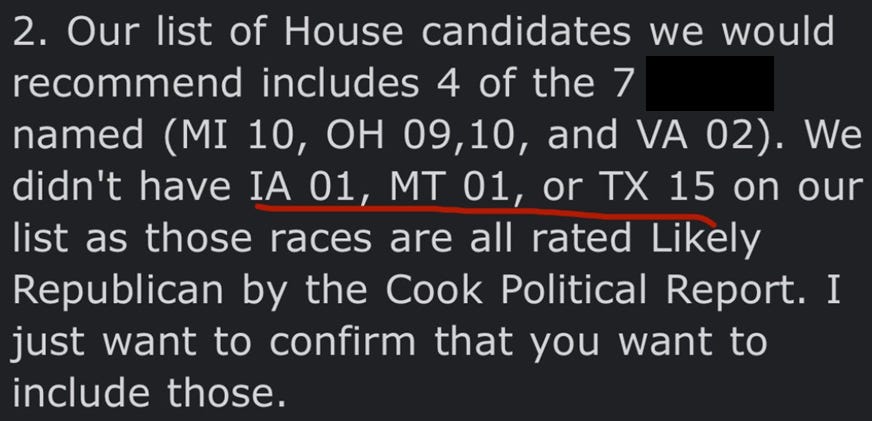
That race, IA-01, ended up as the closest Republican victory of 2024. And the Democratic candidate’s fundraising only caught up with her counterparts in competitive seats when Cook changed IA-01’s rating to Lean R two months before the election.
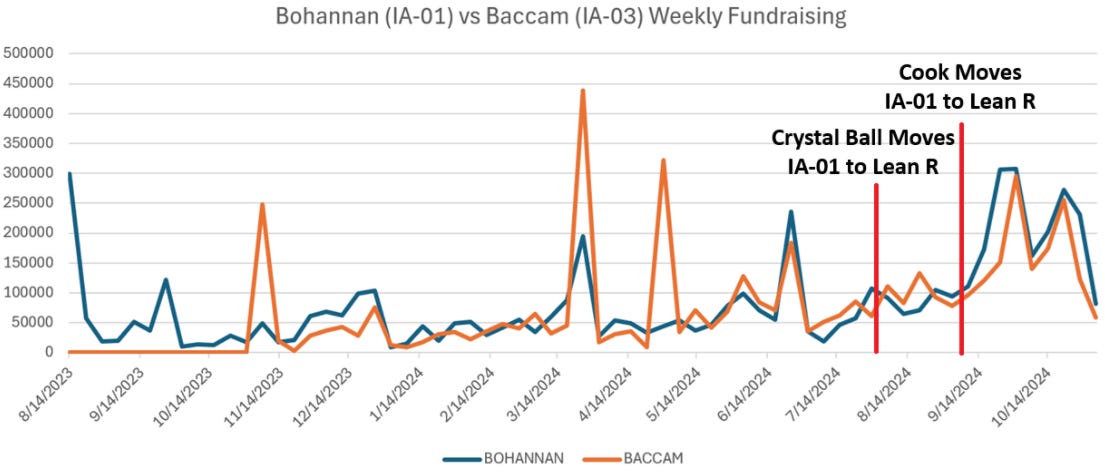
Now, imagine being Shomari Figures, and trying to convince a donor that Cook is wrong, and their money is not going straight into a Safe R furnace. Or convincing volunteers that his race is worth their time.
And that, folks, is why this all matters. And why it’s important to provide respectful feedback and keep the experts accountable. Because rich, important people listen to the experts. And the experts just told them Shomari Figures isn’t worth their time.
@ethan the overall analysis is worth noting. Less so the conclusions for THIS district. Logic feels a little stretched. First of all 0.4 to 1.7 is a huge almost 3X difference, meaningful when every point counts. Moreover you won't look at national averages alone when you have data for THIS incumbent and it's indicating a 0.4 incumbency advantage. Secondly while yes a state CAN be above national baseline but if any state comes in below the national swing towards D, it's Alabama. Trump approval is still net positive in Alabama and many disapprovers will still vote R. (WWC evangelicals etc where D brand is too toxic to switch)
Overall I would say this is borderline between Likely R and Safe R and Cook is right to wait for evidence of a bigger national swing or quality local polling before changing.
WI-08 (Green Bay) could use some analysis too. Though Wisconsin primaries are so late that it may be hard to assess candidate strength